Latest Animal :
Recent Animals
Showing posts with label bears. Show all posts

Polar Bear Migration Season Fully Underway


Winter season is migration season. In the past month alone, a small town in Canada had seen hundreds of polar bears make the annual trudge back to Hudson Bay, where the ice is freezing once more after the summer melt. Each autumn, the bears pass by the town of Churchill, in Manitoba, Canada, considered as the “polar bear capital of the world.”
Because of their regular annual migration, this group of polar bears is also known as the most studied group of polar bears in the world, with the renowned Dr. Ian Stirling first beginning his groundbreaking research on these animals some 40 years ago.  The regularity in which this particular population comes ashore each year also makes them easy to count, as Steven Amstrup of  Polar Bears International points out.

With a population of just 900 people, Churchill is no doubt a small town, but it boasts of having several hotels, with tourists coming in droves during the winter to see the polar bear migration. The tourist draw is further enhanced by regular sightings of adorable beluga whales at the Churchill River’s mouth. Its’ estimated that around 10,000 tourists make the trip to this town each year.

With the seasonal freeze approaching, polar bears have consistently gathered along Cape Churchill’s coastal areas, giving people the opportunity to see these majestic animals in the   form the safety of tundra buggies, huge all-terrain vehicles that shuttle out tourists during the winter.

To prevent bear attacks, though uncommon but are known to happen, Churchill residents make a racket and fire shotguns with rubber bullets to ward off the animals. The town also closed its dump, which used to draw the bears.

Read the full story on National Geographic.


{[['']]}

Climate Change Affects Hudson Bay Polar Bear Population


The seasonal ice freeze in Hudson Bay is underway, which makes it time for the regular migration polar bears make to the coastal areas of Churchil, Manitoba.

Ursus maritimus, the largest bear in the world and the apex predator in the Arctic, relies heavily on sea ice for survival. These patches of frozen seawater serve as a crucial platform for the bears to hunt for ringed and bearded seals.
During the summer, when the ice melts for several months, polar bears go inland, conserving their energy in what’s known as a ‘walking hibernation; state. This was the cycle for hundreds of years, but serious changes are affecting polar bears, particularly the populations that regular come to Hudson Bay.

Research for the past 40 years shows sea ice cover in the Arctic declined by as much as 30 percent since 1979. According to Steven Armstupf of Polar Bears International, as greenhouse gases continue to reach ocean temperatures, polar bears are finding themselves staying longer on land.

For instance, the Hudson Bay polar bear population now spends an average of close to 30 days longer than they did three decades ago. That means the bears end up losing more weight, about 2 pounds, according to research, for each day they spend on land, and are therefore lighter by 60 pounds than they were 30 years ago.

This drop in weight also means polar bears are giving birth to smaller cubs, which can lead to problems surviving in the wild.  It’s theorized that polar bears ‘will be the first to go’ in a warming world, since depend on a habitat that melts once temperatures rise. If nothing changes, these animals could go extinct in the wild by 2050.

Read the full story on National Geographic.


{[['']]}

Sun Bears


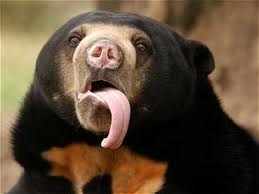
As a member of the Ursidae or bear family, the Sun Bear is known for being the smallest in terms of size, sporting a coat that is described as sleek and short.

Primarily found in parts of Southeast Asia and in Northeast India, Sun Bears are characteristically known for a U-shaped coat pattern found on its chest, typically bearing a light pale-orange hue that contrasts with the dark hued coat that covers its entire body.
Sun Bear
As with most bears, Sun Bears are omnivores, with a notorious reputation for consuming a wide range of food types, including insects, plants, lizards, birds, roots.

Known to be solitary bears, Sun Bears are not typically found in groups, with a number of theories noting that this particular Sun Bear trait is borne from the reality of food source competition. Non-hibernating, Sun Bears are also known to reproduce all-year long, not owing the rise of Sun Bear populations to mating seasons or periods.

Though they are the smallest of bears in the world, adult Sun Bears doesn’t really have their own “set” of natural predators, though instances of adult Sun Bears being overwhelmed by pythons, tigers and leopards are known to happen.

But when human threats are concerned, Sun Bear populations have been drastically affected, mostly in cases involving “nuisance bears”, where bears find their way into human habitats thereby causing damage to crops or stores, leaving them to be “hunted down” by affected parties.

Mostly nocturnal, the Sun Bear’s name is somewhat a paradox, a twist to the “Sun” word that is used to define it as a bear species. Given their size, they are also kept as pets in certain households where they are found, but regulations and control on their keeping as pets is being closely watched over by authorized enforcement agencies.
Sun Bear

Sun Bear

Sun Bear

Sun Bear

 
{[['']]}

Grizzly Bear Facts


As countless children’s books, comics, movies and stories would attest, the Grizzly Bear is one of the world’s most well-loved among forest creatures, popularized by its large “hearty” size and its generally docile nature.

Essentially a sub-species of the North American Brown Bear, Grizzlies were under the spotlight in the Open Season trilogy of movies, with Open Season 3 being the last installment.
Telling the story of how Boog, the main protagonist of the movie, got involved with Russian Grizzly Bears who were part of a traveling circus troupe, the movie looked into different aspects of the life of Grizzlies, with a two-fold approach in showing the life of free, wild Grizzlies and those kept in captivity.

Though everyone is quite aware of how Grizzly Bears can well adjust to controlled domesticated habitats, not everyone is aware that they are the largest known land-based predatorial mammals, a standing that is seconded by the Tiger.

However, though they are predators and are at the top of the food chain in their habitats, their diets regularly consist of nuts and berries, along with fruits, roots and leaves.

Also, though Grizzlies are typically depicted as slow moving creatures due to their size, they are actually quite fast, with the Grizzly’s top running speed rated to be somewhere close to 48 kilometers per hour.

As a threat to human beings, the Grizzly Bear is known to be one creature that is best avoided, regardless of their status as “passive” creatures. In fact, people are always advised to keep their distance when a Grizzly Bear is around, most especially when a mother Grizzly Bear is with her cubs.

Though not exactly liable to attack unless provoked, countless efforts by different sanctioned enforcement agencies do what they can in controlling instances when Grizzly Bears meet with human beings or human populations.

Smart and highly adaptable, Grizzlies are truly among the more majestic and interesting of Mother Nature’s creatures.


 Grizzly Bear Facts
 
{[['']]}

Bears


Bears are typically depicted as cute lovable creatures, whose cuddly bulks have been defined in countless stuffed toys and cute cartoon characters.

From Yogi to Boo-boo, there have been a number of movies and shows which feature bears as their respective central characters, but it is the 1988 released The Bear which stands to be the most unique, having the least amount of human characters and human dialogue involved in the story’s overall plot.
Bears
In its telling, The Bear is essentially a movie about a young orphan bear and how the little tyke managed to find the company of an adult male bear, with both bears faced with the challenge of avoiding overzealous hunters.

Though bears aren’t always described to be the most “family oriented” of mammals, cases of bears adopting stray cubs are known to exist, just as case of male bears killing bear cubs are also known to be, commonly occurring with American Black Bears.

In taxonomic terms, bears are part of the Ursidae family, categorized as dog-like carnivores. There are eight currently known living bear species, including bears like the Giant Panda, the Sloth, the Alaskan Brown Bear and more.

As creatures, bears come in different sizes and are found in different habitats scattered in different parts of the world. Mostly solitary, cases of bears hanging around in groups are considered to be rare, and while many are convinced that bears are nocturnal creatures, the truth couldn’t be farther from that “nocturnal” association, with different bear species known to be diurnal and/or crepuscular.

Given the way bears are depicted by today’s standards of cultural trends and movements, they are often defined as bulky cuddly creatures, but the truth about bears is that they are not really all cuddly.

As one of the world’s bigger land mammals, bears continue to be one of the most well known and well loved creatures.
Bear

Bear

Bear

Bear
Bears Video
 
{[['']]}

Bear Sloth


Many children’s stories have been turned into movies by Walt Disney. One such story is the classic compilation of novels by Rudyard Kipling called the Jungle Book. In the animated movie based on the book, a boy named Mowgli grows up in the jungles of India with wolves. Together with a black panther named Bagheera and the bear sloth Baloo, he fights for his life against an evil tiger named Shere Khan.
Bear Sloth
One of the main characters of the movie is the fun loving bear sloth Baloo. Bear sloths are very common in the Indian jungles, going also by the name of labiated bears. They are nocturnal insectivores, meaning they are most active at night and live off insects and other small, similar creatures. Many scientists have traced the bear sloth’s heritage to the brown bear. Unlike the black and brown bears however, a bear sloth has a lankier build. They have long, rough, shaggy coats, which form a mane around their neck. They also have claws that are sickle-shaped, make it easier for them to scoop out bugs, while their lower lips are specially adapted for sucking the insects out of their nets, thus making them very close to sloths.  They feed during early spring through summer time and have their babies during the start of winter.

Bear sloths mostly live off honeybee colonies, fruits and termites. There are very few known bear sloth attacks on humans, but these bears can actually get very aggressive if provoked or if they are protecting their territory or cubs. Unfortunately, the bear sloth’s natural habitats have been drastically reduced by human development. Poachers and hunters have also reduced their population due to excessive hunting for their claws and baculum. Many have also captured these bears and placed them in circus and shows because they are very easy to tame.
Bear Sloth

Bear Sloth picture

Bear Sloth

Bear Sloth pictures
Bear Sloth Video
 
{[['']]}

Bears


Bears have taken a popular spot in a number of animated classic features and cartoons, with Yogi Bear and his ever-loyal sidekick Boo boo, being among the most famous and popular.

First appearing as a supporting character in the Hanna-Barbera produced The Huckleberry Hound Show in 1958, Yogi eventually got to have his own show which eventually came out with a string of supporting characters like Boo Boo, Cindy Bear and Ranger Smith.
Brown Bear
In 2010, a real live/CGI feature Yogi Bear feature was produced, featuring the voice talents of Dan Aykroyd, Justin Timberlake and Anna Faris. The movie, though featuring a more than 50 year old character, didn’t exactly become the Hollywood breakthrough which was expected to be.

To the tune of most cartoon personalities of the time, Yogi’s personality was based on the personality on the Ed Norton character of The Honeymooners.

As a bear, his penchant for “stealing picnic baskets” is very well established, one which has played a pivotal role in the development of the series central plot. Bears, in real life, are notorious for “raiding” the food supplies of campers or natural park picnickers, but this “bear aspect” isn’t driven by the mischief and hunger drives which motivate Yogi.

Hunger remains to be the main motivation why bears often raid picnic baskets and such, oftentimes causing fear and distress among picnickers.

Generally, bears don’t attack people unless they are provoked, and as natural creatures, they are known to use their massive size to intimidate, rather than to attack. Feeding the bears in national parks are not a good idea, since this would only encourage them to frequent designated picnic areas and facilities.

Should you ever find yourself in a natural park picnic situation, verify the presence of bears in a given zone/area with park rangers before spreading your picnic blanket. Though most designated picnic areas are fenced to keep bears out, there’s the off chance of a bear managing to find a way in, which would result to a “Yogi bear” scenario, where picnic baskets get swiped.
Black Bear

Brown Bear pictures

Black Bear image

Polar Bear

Polar Bear image
 Bears Video
{[['']]}

Polar bear

polar bear cute wild animal wallpaper
Polar Bear
As the name implies Polar Bears live in areas surrounding the North Pole, on which is the Arctic Ocean (there are no polar bears in Antarctica). Polar bears are relatives of the brown bear, but much larger—in fact, polar bears, along with Kodiak bears, are the biggest land carnivores living today.

Their main diet are seals, which they catch when these seals are trying to reach for air above the ice. Polar bears locate the ice holes and the seals using their very keen sense of smell. Polar bears also feed on walruses whenever they can. Polar bears are also good swimmers but they don’t usually swim when hunting.

Polar bears have become physically adapted to living in the polar regions, evolving snowy fur, large paws with traction, and a thick skin so it can withstand even frigid water.

polar bear cute wild animal wallpaper
Cute Little Polar Bear

polar bear cute wild animal wallpaper
Polar Bear
was hunting

polar bear swim wild animal wallpaperpolar bear swim cute wild animal wallpaper
Polar Bear swimming
animal wallpaper

polar bear cute wild animal wallpaper
Bears were relaxing picture

polar bear cute wild animal wallpaperpolar bear cute wild animal wallpaper
Polar Bear
funny animal picture
{[['']]}
 
Copyright © Animals Library - All Rights Reserved
Proudly powered by Blogger