Latest Animal :
Recent Animals
Showing posts with label axolotl. Show all posts

Pokemon Comes to Life

The popular cartoon show Pokemon has captured the imagination of generations of people with their monsters and creatures that look like a mixture of two or three different animal. However, some creatures featured in the TV show resemble real life animals that fans are wanting to get them as pets.
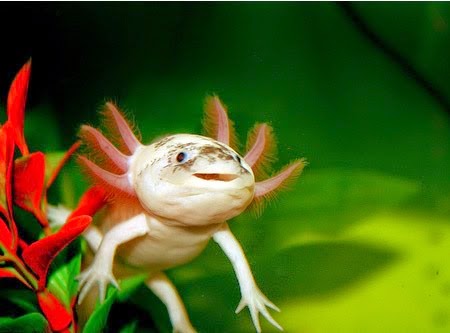
Pictures of axolotls, which are commonly known as Mexican Walking Fish, became viral on the internet because of their very close resemblance of the pokemon Mudkip. These animals have actually been bred in captivity and have been sold as pets for years. Although most people call them fishes, they’re actually amphibians. These animals are salamanders under the order Caudata/Urodela. They’re more closely related to frogs compared to fishes. Another common misconception about these animals is that they’re reptiles or lizards. However, amphibians are actually a whole different thing. Salamanders might resemble lizards, however they are a very different thing.

Captivity breed axolotls come in a variety of colors, including white albino, golden albino, leucistic or white with black eyes, different shades of brown, gray and the ever so popular blue. Other varieties also have solid colors like the melanoids which are nearly all black. Wild axolotls commonly are colored between the color rage of cream, brown or black. Some specimens also have a mixture of two or more colors.


They’re best placed in a cold environment. Lower temperatures may result to slower metabolism while higher temperatures could cause them stress and an increased appetite. They’re commonly feed salmon and trout pellets, live or frozen bloodworms, waxworms and earthworms.
{[['']]}

Researchers build Axolotl shelters in Xochimilco, Mexico

Axolotls or known as "water monsters" are salamander-like creatures that are only found in Xochimilco and its other connected lakes and canals.

Researchers attempted to capture the endangered creatures to save their alarming fall in number. Shelters are built in Xochimilco to help them breed. They are built with sacks of rocks and several plants' stalks for filters where a clean water is pumped in.  Aquariums and water tanks are discouraged due to the possibilities of interbreeding that may result in some mutations and other risks like, spreading fungus infections when released into the wild.
AP Photo/Dario Lopez-Mills

Axolotls are important in scientific research due its tissue regeneration ability. A statement from the Mexican
Academy of Sciences claimed that an average of 6,000 axolotls for every square kilometer were found in a 1998-survey, but in 2003, the figure fell to only a thousand, and by 2008, a survey claimed there are only a hundred. At present, researchers were relieved at the sight of two axolotls in the first three weeks for this year's survey.


Read details here.
{[['']]}

Mexico’s ‘water monster’ may be extinct

Mexico’s salamander-like axolotl may have gone extinct from its only known natural habitat in Mexico City’s lakes.
axolotl
The animals’ only habitat in the wild is Lake Xochimilco, which is struggling in the face of heavy pollution and expanding urban reach.

Source: Here
{[['']]}

The Axolotl

The ‘Forever Baby’ Monster

Axolotl
Meet the Axolotl, a relative of the tiger salamander—Ambystoma tigrinum. The Axolotl’s scientific name is Ambystoma mexicanum. (‘Ambystoma’ means “blunt mouth.”)
The word ‘Axolotl’ comes from the Aztec language (Nahuatl) meaning “water monster,” or “water dog.” Indeed, when a normal colored Axolotl (brown, with spots) is viewed face on in an aquarium, with no eyelids, no teeth, three feathery horn-like gills at each side behind its head, it does resemble a funny-faced dragon. The goofy appearance is more pronounced in light pink (leucistic) Axolotls, which look smiley-faced with feathery red gills. Some people pointed out they look like the PokemonTM Mudkip.
Axolotl

Axolotl

Axolotl

The secret to this goofy appearance is neoteny—the adult body proportions and parts develop very slowly or never at all. This means that Axolotls are forever babies—retaining tail fins and gills that, in other salamander species, disappear when they totally depend on their lungs and leave the water for dry land. The Axolotl, however, remains in the water. But, even if they have the body characteristics of babies, Axolotls grow in size in the water and they also breed. The ability to breed while retaining baby characteristics is called pedogenesis.
What’s more amazing is the Axolotl’s ability to regrow lost or damaged body parts. While many lizards can grow back lost tails, Axolotls and salamanders can grow back lost limbs, eyes, and other organs. This ability is now being studied by scientists in the hope of bringing this ability to humans
The Axolotl comes in a variety of colors—chocolate brown, near black, leucistic (pink or white with black eyes), white albino or golden albino, grey, cream or piebald (and combinations of these). These variations in color makes the Axolotl a favorite of amphibian-lovers—together with frogs, toads, other salamanders, and newts (OK, maybe not including the presidential candidate).
Axolotl

Axolotl

As pets, Axolotls are kept in largish aquariums (around 40 liters or 11 US gallons) with at least 6 inches of water. Though they have lungs, they rely mostly on their gills to breathe. Since they still have baby characteristics, Axolotls must be protected from skin and gill injuries, hence their aquariums are usually padded with fine sand, not gravel. They should also be kept at temperatures between 17–18°C (63–64°F)—like the temperatures of their native lake habitats.
Since they are carnivores (gulping down whatever smells good to eat in the wild) Axolotls are fed live or dried fish food like earthworms, bloodworms, or even fish food pellets.
Axolotls thrive well in captivity. In fact, if not for their ability to reproduce while captive, Axolotls would be on their way to extinction, because their native lakes—Chalco (drained) and Xochimilco (polluted) are no more. Wild Axolotls are very very endangered.
{[['']]}
 
Copyright © Animals Library - All Rights Reserved
Proudly powered by Blogger